

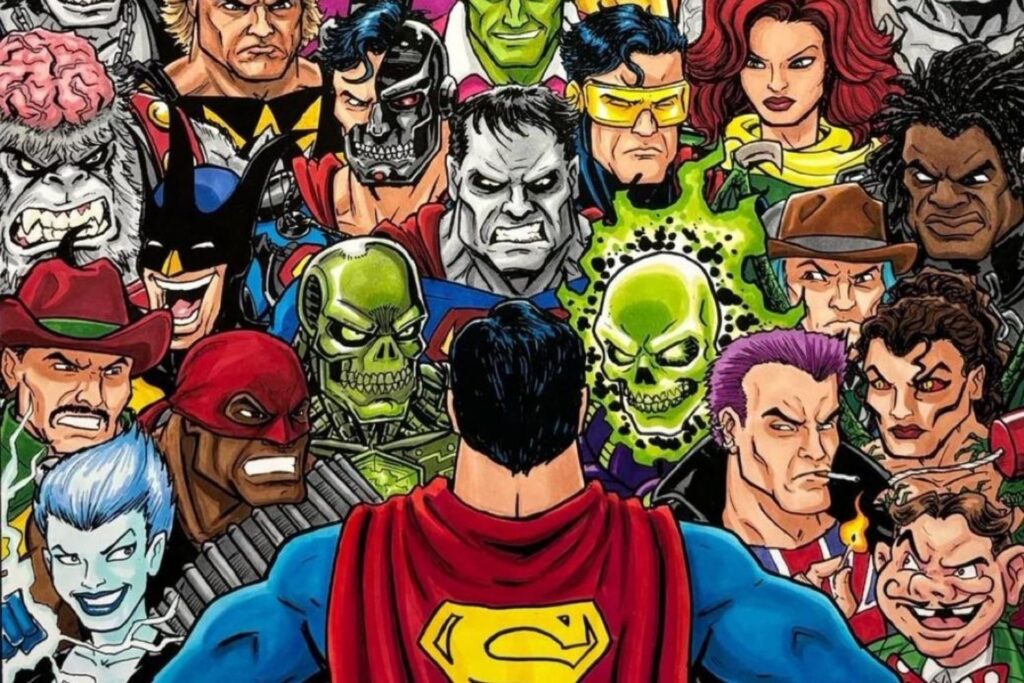
If you have spent any real time with Superman comics, you already know the problem. Superman is too strong for most of his villains. He lifts things that writers probably regret specifying. He survives damage that should end entire franchises. A lot of enemies exist to be dramatic speed bumps.
So when people search Superman villains ranked by power, what they usually want is not trivia. They want clarity. They want to know who can actually hurt him, who can beat him, and who forces the story to cheat just to keep Superman alive.
Now here is what most rankings miss. Superman’s villains are powerful in different ways. Some overpower him. Some outlast him. Some trap him in situations where strength stops mattering. A few operate on a scale where Superman is just another variable inside a much bigger problem.
That is why clean numbered lists always feel wrong.
This guide ranks Superman villains by power using tiers, then points you toward the stories where that power actually shows up. Reputation does not count if it never translates on the page.
Cape optional.
Who Are Superman’s Strongest Villains?
Across Screen Rant, CBR, Collider, GameRant, Looper, SlashFilm, and FandomWire, the same names keep appearing at the top. That consistency matters. It tells us there is a shared understanding of who belongs in Superman’s highest threat category, even if the exact order changes.
The most commonly cited top-tier villains include:
- Mister Mxyzptlk
- Superboy-Prime
- Darkseid
- Doomsday
- Anti-Monitor
- Imperiex
- Brainiac
- Lex Luthor
- Mongul
- Cyborg Superman
What changes between lists is how “power” gets defined. Some rankings focus purely on physical strength. Others factor in reality warping, cosmic scale, intelligence, and long-term damage. This article does not pretend there is one correct metric.
Instead, it uses all of them.
How We Ranked Superman Villains by Power
Power in Superman stories is about win conditions, not gym stats.
This ranking considers four things.
Raw physical power.
Can this villain overpower Superman directly, without gimmicks or perfect circumstances.
Scale of threat.
Does the villain threaten a city, a planet, a universe, or the multiverse.
Rule-breaking ability.
Reality warping, magic, time manipulation, and narrative-level cheating all count.
Consistency in canon.
One lucky punch does not outweigh decades of losses.
Comic book versions are the baseline. Film and television versions are referenced only to highlight how much weaker or stronger a character becomes outside print. If a villain feels terrifying in a movie but struggles in comics, that gets noted. If a villain barely appears on screen but dominates entire comic eras, that matters more.
Now let’s get into the tiers.
Tier 1: Reality Breakers and Cosmic Threats
These villains do not fight Superman. They invalidate him.
Mister Mxyzptlk
Mxyzptlk sits alone at the top, and that is not up for debate. He is not strong in the traditional sense. He is strong because the rules do not apply to him. Fifth-dimensional physics make Superman’s power set irrelevant. Strength, speed, durability, and experience all stop mattering once reality itself becomes a toy.
Superman does not defeat Mxyzptlk by overpowering him. He defeats him by tricking him, outlasting him, or exploiting self-imposed rules. That alone tells you everything you need to know.
- Key reading: Superman Vol. 1 #30, Whatever Happened to the Man of Tomorrow?
- Collector note: Early Mxyzptlk appearances remain undervalued for how central he is to Superman lore.
Anti-Monitor
The Anti-Monitor operates on a scale Superman can barely influence. He consumes universes. He shrugs off god-level resistance. Even at his weakest, he requires entire teams, artifacts, and cosmic sacrifices to slow him down.
Superman can fight him. Superman cannot stop him alone.
That distinction matters.
- Key reading: Crisis on Infinite Earths #1–12
- Collector note: Crisis-era keys remain foundational DC books with long-term stability.
Imperiex
Imperiex exists to erase flawed universes and start over. His armor channels entropy itself. His presence destabilizes reality. Superman’s victories against Imperiex are never clean and never solo.
Imperiex represents the kind of threat where survival counts as success.
- Key reading: Our Worlds at War crossover
- Collector note: Underrated event books with strong villain presence.
Tier 2: World Breakers and God-Level Enemies
These villains can beat Superman in a straight fight or grind him down through sheer scale.
Darkseid
Darkseid is not just strong. Darkseid is inevitable. The Omega Effect alone puts him in god territory. Add his immortality, strategic mind, and control over Apokolips, and Superman is always fighting uphill.
Darkseid loses battles. He rarely loses wars.
- Key reading: Final Crisis, Superman/Batman Vol. 1
- Collector note: Kirby-era Darkseid remains peak long-term value.
Superboy-Prime
Superboy-Prime is what happens when Superman’s power loses restraint. He punches through reality. He alters timelines by accident. He treats veteran heroes like speed bumps.
Prime is dangerous because he combines Kryptonian power with emotional instability and zero limits.
- Key reading: Infinite Crisis #1–7
- Collector note: Prime keys spike whenever DC revisits multiversal chaos.
Doomsday
Doomsday does one thing perfectly. He kills Superman.
Adaptation makes him immune to whatever killed him last time. No speeches. No schemes. No mercy. Superman does not outthink Doomsday. He endures him.
- Key reading: The Death of Superman
- Collector note: Iconic books with permanent cultural relevance.
Mongul
Mongul is raw power with imperial ambition. He has beaten Superman physically and psychologically. Underestimate him and you get Warworld.
- Key reading: For the Man Who Has Everything
- Collector note: Moore-era stories always age well.
Tier 3: Tactical Nightmares and Kryptonian Mirrors
These villains win by preparation, persistence, or exploiting Superman’s limits.
Brainiac
Brainiac is not stronger than Superman. He does not need to be. His intellect, technology, and long-term planning consistently outmaneuver raw power. Brainiac turns Superman’s strength into a liability.
- Key reading: Action Comics #866–870
- Collector note: Modern Brainiac keys remain accessible.
Lex Luthor
Lex Luthor belongs here because preparation is power. Given time, resources, and motivation, Lex consistently builds scenarios where Superman cannot win cleanly. That counts.
- Key reading: All-Star Superman
- Collector note: Prestige formats hold collector appeal.
Cyborg Superman
Hank Henshaw blends Kryptonian durability with machine logic and zero restraint. He matches Superman physically while removing empathy from the equation.
- Key reading: Reign of the Supermen
- Collector note: Death-era continuity still drives demand.
Collector Box: Key Villains and First Appearances
| Villain | First Appearance | Defining Power Moment | Collector Value Hint |
| Mister Mxyzptlk | Superman #30 | Casual reality manipulation with no physical limits | Consistent sleeper keys |
| Superboy-Prime | DC Comics Presents #87 | Punches that fracture reality itself | Event-driven spikes |
| Darkseid | Superman’s Pal Jimmy Olsen #134 | Omega Effect dominance over gods and heroes | Blue-chip DC villain |
| Doomsday | Superman #75 | Killing Superman in canon | Evergreen demand |
| Brainiac | Action Comics #242 | Bottling cities as trophies | Long-term stability |
| Lex Luthor | Action Comics #23 | Outsmarting Superman through planning and tech | Foundational villain |
| Anti-Monitor | Crisis on Infinite Earths #2 | Multiversal destruction | Event cornerstone |
| Imperiex | Superman #153 | Universal reset campaigns | Undervalued |
TL;DR: Don’t Pick a Fight with a 5th Dimensional Imp
Ranking Superman villains by power only works if you respect the scale of the stories. Punching strength matters. Reality control matters more. Preparation, persistence, and narrative pressure often matter most of all.
Superman is unbeatable until he is not. The villains above are the reason that sentence keeps getting tested.
And those are the ones worth reading.